

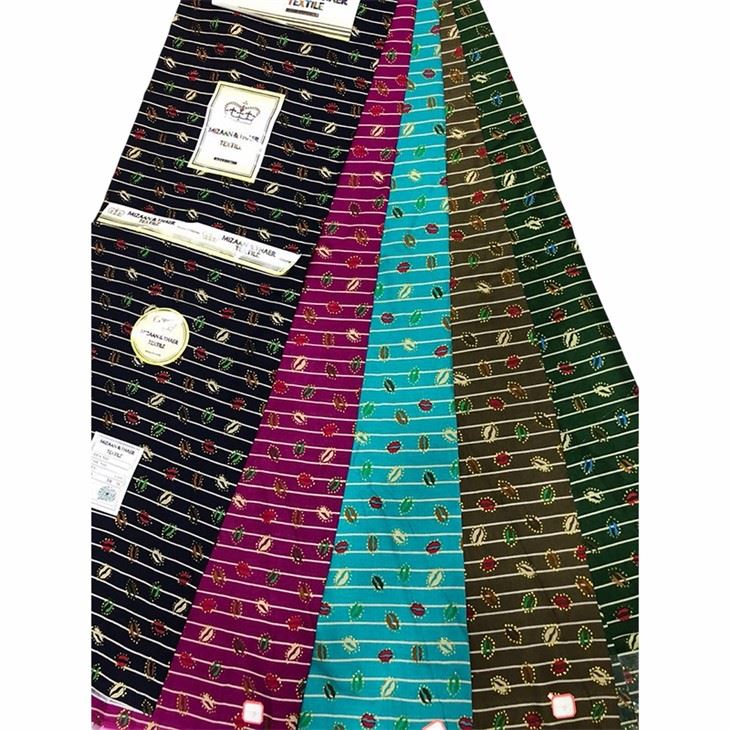
As a supplier of Rayon Dobby Premium, I understand the frustration that static electricity can bring to both manufacturers and end - users. Static on Rayon Dobby Premium not only affects the aesthetic appearance of the fabric but also can cause discomfort during handling and wearing. In this blog, I will share several effective methods to reduce static on Rayon Dobby Premium.
Understanding the Cause of Static on Rayon Dobby Premium
Before we delve into the solutions, it's crucial to understand why static occurs on Rayon Dobby Premium. Static electricity is generated when two materials come into contact and then separate, causing an imbalance of electric charges. Rayon, a semi - synthetic fiber made from cellulose, has a relatively high dielectric constant. When Rayon Dobby Premium rubs against other materials, such as skin, clothing, or packaging materials, electrons are transferred, resulting in a build - up of static charges.

Environmental factors also play a significant role. Low humidity levels, commonly found in air - conditioned environments or during the winter months, exacerbate static problems. In dry air, the electric charges on the fabric cannot dissipate easily, leading to a more noticeable static effect.
Humidity Control
One of the most straightforward ways to reduce static on Rayon Dobby Premium is to control the humidity. As mentioned earlier, low humidity is a major contributor to static build - up. By increasing the humidity in the storage and processing areas, we can help the fabric dissipate static charges more effectively.
A simple and cost - effective method is to use a humidifier. Place a humidifier in the room where the Rayon Dobby Premium is stored or processed. Aim for a relative humidity level between 40% and 60%. At this humidity range, the air contains enough moisture to allow the static charges on the fabric to leak away.
In addition to using a humidifier, you can also introduce natural moisture sources. For example, placing bowls of water around the room can gradually increase the humidity. However, this method is less precise and may not be sufficient in large areas.
Anti - Static Agents
Anti - static agents are chemicals designed to reduce or eliminate static electricity on surfaces. There are two main types of anti - static agents that can be used on Rayon Dobby Premium: topical and internal.
Topical anti - static agents are applied to the surface of the fabric after it has been manufactured. These agents work by forming a thin, conductive layer on the fabric surface, which helps to dissipate static charges. You can apply topical anti - static agents using a spray or a dipping process. Make sure to follow the manufacturer's instructions carefully to ensure proper application and effectiveness.
Internal anti - static agents are added during the manufacturing process of the Rayon Dobby Premium. These agents are incorporated into the fiber structure, providing long - lasting anti - static properties. While internal anti - static agents are more effective in the long run, they require more complex manufacturing processes and may increase the production cost.
Proper Handling and Storage
Proper handling and storage practices can also help reduce static on Rayon Dobby Premium. When handling the fabric, avoid rough rubbing or friction. Use smooth, gentle movements to minimize the generation of static charges.
When storing the fabric, choose a suitable storage environment. Avoid storing Rayon Dobby Premium near sources of static, such as plastic or synthetic materials. Instead, use natural fiber storage containers or wrapping materials, such as cotton or linen. These natural fibers are less likely to generate static and can help prevent static transfer to the Rayon Dobby Premium.
Grounding
Grounding is a technique used to discharge static electricity safely. By connecting the fabric or the equipment used to handle the fabric to the ground, the static charges can flow away, reducing the static build - up.
In a manufacturing or processing environment, you can ground the machinery used to handle Rayon Dobby Premium. This can be done by connecting the equipment to a grounding rod or a grounding wire. Make sure the grounding system is properly installed and maintained to ensure its effectiveness.
For small - scale operations or when handling the fabric manually, you can use a grounding strap. A grounding strap is a simple device that can be worn on the wrist and connected to a grounded object. This helps to discharge any static charges that may build up on your body while handling the fabric.
Choosing Compatible Materials
When using Rayon Dobby Premium in combination with other materials, it's important to choose compatible materials to reduce static. Avoid pairing Rayon Dobby Premium with materials that are known to generate a lot of static, such as polyester or nylon.
Instead, opt for natural fibers like cotton or silk. These natural fibers have a lower tendency to generate static and are more compatible with Rayon Dobby Premium. For example, when making clothing, you can line the Rayon Dobby Premium garments with cotton fabric to reduce static and improve comfort.
Conclusion
Reducing static on Rayon Dobby Premium requires a multi - faceted approach. By controlling humidity, using anti - static agents, practicing proper handling and storage, implementing grounding techniques, and choosing compatible materials, we can effectively reduce the static problem on Rayon Dobby Premium.
As a supplier of Rayon Dobby Premium, I am committed to providing high - quality products and solutions to our customers. If you are interested in our 100% Rayon Fabric Printed, African Fabrics for Somali Batti, or Rayon Gold Print Fabric, or if you have any questions about reducing static on Rayon Dobby Premium, please feel free to contact us for further discussion and procurement negotiation.
References
- "Textile Science and Technology: Volume 1 - Fibre to Yarn" by H. - K. Rouette
- "Handbook of Fiber Chemistry" by Menachem Lewin and Eli M. Pearce
- "Textile Testing and Quality Control" by B. C. Das