

As a supplier of Rayon Fabric Mills, ensuring the consistency of our fabric products is of utmost importance. Consistency not only builds trust among our customers but also reflects the quality and reliability of our brand. In this blog, I will delve into the various strategies and practices we employ to guarantee that every batch of our rayon fabrics meets the same high - standard requirements.
Raw Material Sourcing
The journey of consistent fabric production begins with the careful selection of raw materials. Rayon is a semi - synthetic fiber made from cellulose, typically derived from wood pulp or bamboo. We have established long - term partnerships with reputable suppliers who adhere to strict quality control measures. These suppliers are required to provide detailed certificates of origin and quality analysis for each batch of raw materials.
We conduct in - house tests on the incoming raw materials to verify their purity, viscosity, and fiber length. For instance, the viscosity of the cellulose solution used in rayon production can significantly affect the strength and texture of the final fabric. By closely monitoring these parameters, we can ensure that the raw materials are consistent in quality, which is the foundation for consistent fabric output.
Standardized Manufacturing Processes
Our manufacturing processes are highly standardized to minimize variations in fabric production. We have developed detailed operating procedures for each step, from spinning to weaving and finishing.
Spinning
During the spinning process, we use advanced machinery that is calibrated regularly to maintain consistent yarn quality. The speed of the spinning machines, the tension applied to the fibers, and the temperature and humidity in the spinning room are all carefully controlled. For example, if the spinning speed is too high, the yarn may be too thin and weak, while a slow speed may result in a thicker and less uniform yarn. By keeping these variables within a narrow range, we can produce yarns with consistent thickness, strength, and twist.
Weaving
In the weaving stage, we use state - of - the - art looms that are programmed to create specific weave patterns. The settings for the loom, such as the warp and weft densities, are pre - determined based on the desired fabric specifications. Our operators are highly trained to monitor the weaving process continuously. They check for any irregularities in the fabric, such as broken threads or uneven tension, and make immediate adjustments to ensure that the fabric has a consistent appearance and structure.
Finishing
The finishing process is crucial for enhancing the fabric's properties and appearance. We use a range of finishing treatments, such as dyeing, printing, and softening. For dyeing, we use high - quality dyes and precise color - matching systems. Our technicians conduct color tests on small samples before dyeing large batches of fabric to ensure that the color is consistent and matches the customer's requirements.
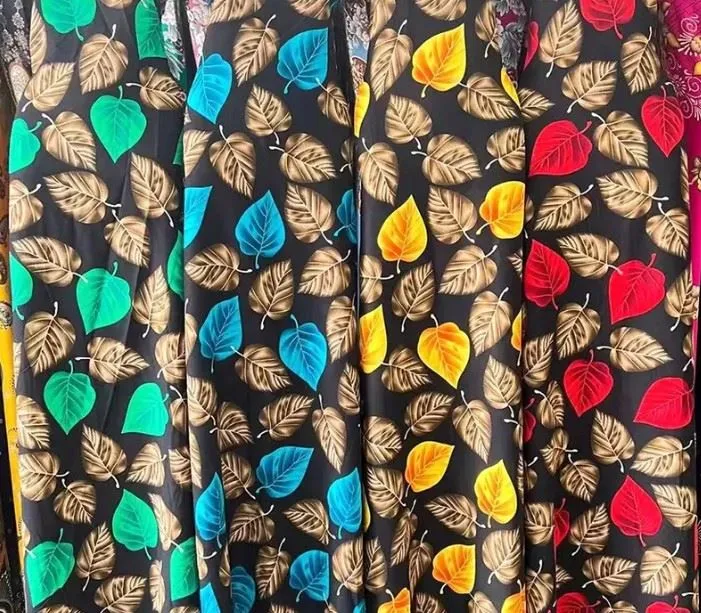
When it comes to printing, we have advanced printing machines that can reproduce intricate designs with high precision. For example, our Floral Print Rayon Fabric and Printed Rayon Challis Fabric are produced using these state - of - the - art printing techniques. The pressure, temperature, and ink flow during the printing process are carefully controlled to ensure that the prints are sharp, clear, and evenly distributed across the fabric.
Quality Control at Every Stage
Quality control is an integral part of our production process. We have a dedicated quality control team that conducts inspections at multiple stages of production.

In - process Inspections
During the manufacturing process, our quality control inspectors conduct regular checks on the semi - finished products. They examine the yarns, woven fabrics, and dyed or printed fabrics for any defects. For example, they check for uneven dyeing, loose threads, or printing errors. If any issues are detected, the production process is immediately halted, and corrective actions are taken.
Final Inspections
Before the fabric products are shipped to our customers, a final inspection is carried out. The fabric is checked for its overall appearance, dimensional stability, colorfastness, and strength. We use standardized testing methods and equipment to ensure accurate and consistent results. For example, we test the colorfastness of the fabric by exposing it to different environmental conditions, such as sunlight, washing, and rubbing. Only the fabrics that meet our strict quality standards are approved for shipment.
Employee Training and Development
Our employees are our most valuable asset, and their skills and knowledge play a crucial role in maintaining the consistency of our fabric products. We provide comprehensive training programs for all our employees, from new recruits to experienced technicians.
Technical Training
Our technicians receive regular training on the operation and maintenance of the manufacturing equipment. They are taught how to troubleshoot common problems and make adjustments to ensure the smooth running of the production process. For example, they learn how to calibrate the spinning machines to produce yarns of consistent quality.
Quality Awareness Training
All employees are also trained in quality awareness. They are made aware of the importance of consistency in fabric production and how their individual actions can impact the final product. By instilling a quality - conscious culture in our workforce, we ensure that everyone takes responsibility for maintaining the high standards of our fabric products.
Data - driven Decision Making
We rely on data to drive our decision - making processes. We collect and analyze data from every stage of production, including raw material quality, machine performance, and quality control results. This data is used to identify trends, detect potential problems, and make informed decisions to improve the production process.
For example, if we notice a trend of increasing color variations in a particular batch of dyed fabric, we can analyze the data related to the dyeing process, such as the dye concentration, temperature, and time. Based on this analysis, we can make adjustments to the dyeing process to reduce the color variations and improve the consistency of the fabric.
Continuous Improvement
Consistency is not a static goal but an ongoing process of improvement. We regularly review our manufacturing processes, quality control measures, and employee training programs to identify areas for improvement.
We also keep an eye on the latest industry trends and technological advancements. We invest in research and development to adopt new technologies and processes that can enhance the consistency and quality of our fabric products. For example, we are exploring the use of new dyes and finishing agents that can improve the colorfastness and softness of our fabrics.
Conclusion
As a supplier of Rayon Fabric Mills, we are committed to ensuring the consistency of our fabric products. Through careful raw material sourcing, standardized manufacturing processes, strict quality control, employee training, data - driven decision making, and continuous improvement, we can provide our customers with high - quality rayon fabrics that meet their expectations every time.
If you are interested in our Printed Fabrics Textiles or other rayon fabric products, we invite you to contact us for procurement discussions. We look forward to establishing long - term partnerships with you and providing you with the best fabric solutions.
References
- "Textile Manufacturing Processes" by J. E. Booth
- "Quality Control in the Textile Industry" by R. K. Shah